
- Europol press release, 16 June 2025, on the coordinated action in Germany, the Netherlands, Romania, Spain and Sweden.
- Eurojust press release, 16 June 2025, on the judicial side of the operation.
A short timeline
- Mid-2025 · AbacusPayouts to vendors stalled and then stopped. The site stayed up long enough for buyers to keep depositing, which is the usual shape of an exit scam: the market keeps taking money after its operator has stopped paying it out, and the last deposits are the largest because trust is highest.
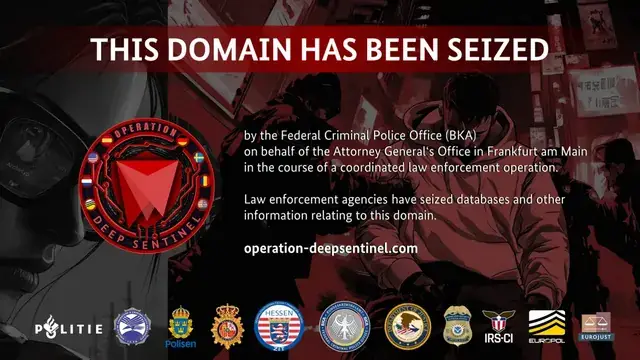
- June 2025 · ArchetypGerman police seized the market in an operation involving several countries. A seizure notice replaced the login page.
- 2025 · ElysiumElysium simply closed. There was no event to point to. Whatever was left on the site became the operator's question, and any mirror that appeared afterwards was not to be trusted.
- Late September 2026 · Nexus and Dark MatterTwo more markets exit-scammed within the same weeks: Nexus and Dark Matter. That leaves TorZon as the one old name still at the top of the list.

The endings side by side
| Market | How it ended | What was at stake for buyers | What could be seen beforehand |
|---|---|---|---|
| Abacus | Exit scam | Balances and open orders | Slow withdrawals, unanswered tickets, disputes left open |
| Archetyp | Seizure by law enforcement | Whatever data the operator kept | Little from the outside |
| Elysium | Closure | Whatever was left on the site | Nothing specific |
The two endings cost buyers differently. In an exit scam the operator takes the money. After a seizure the site belongs to the investigators, and what remains is the data the operator retained, which is why a market that keeps little has a real advantage. DrugHub, for example, keeps almost nothing on its servers by design. A seizure also makes every address that claims to be the market dangerous. That is why our status table keeps the closed markets listed with their real status, so a reader who searches an old name gets a straight answer.
The signs that come before an exit scam
- Vendors complain that withdrawals are slow.
- Support tickets go unanswered.
- Disputes stop being resolved.
- The market suddenly pushes an unusual promotion that asks for deposits.
Any one of these is common on a healthy market. Together they are the pattern. The defence is structural: keep little in your balance, and prefer escrow where the operator cannot empty an order, as in the multisig guide.
Where the traffic went
When well-known markets close, their users do not scatter evenly. They crowd onto the markets with the depth to take them. TorZon took most of the load, and being the largest made it the biggest target for cloned addresses and for law-enforcement attention. Smaller markets such as Black Ops grew the other way, by staying small and vetting vendors, which makes them a harder case for anyone to justify chasing.
Neither route is safe in itself. A market's size and its operator's silence tell you little, and the habits that protect you do not depend on which market you use: verify every address with the PGP verification guide, keep your balance low and treat each platform as temporary.
After a closure, the relaunch claims
Within days of every closure, messages appear announcing a relaunch, a new address or a successor market, often with a copied logo and a convincing story. Treat all of them as hostile unless the claim comes from a message signed with a key you verified before the closure, and even then be slow to deposit. A closed market has no reason to need your coins again.
The pattern is older than 2025
Silk Road was taken down in 2013, AlphaBay in 2017 and Hydra, the largest Russian-language market, in 2022. Each closure sent its users to whatever looked stable next, and a new market grew to fill the gap each time.